The Calamity review comes down to one question: does the final part of the BLEACH Blood War adaptation end the war between the Soul Reapers and the Quincy in a way that does justice to everyone caught up in it? Mostly, yes. The finale stretches the battle to match the threat, keeps a friendship at the centre of the war, handles its new material with some discipline and gives the aftermath an episode of its own. Its one real pressure point is space, because a lot of that ambition has to fit into a single episode.
A war that matches its threat
The best thing The Calamity does is size the battle to Yhwach’s ambition. By Episode 49, THE BLADE, he is no longer a conqueror chasing a throne. According to the official synopsis, he appears in the Soul Society, the World of the Living and Hueco Mundo at the same moment, announcing that he will return the world to nothingness and build a new one free of the fear of life or death. A threat aimed at existence itself cannot be answered by one duel in one place, so spreading the fight across three realms makes the stakes feel physical instead of merely stated. It also gives Yhwach a goal with more to it than destruction, since the fear of death ties his ambition to anxieties the series itself is built around.
The same synopsis notes that he has surpassed even The Almighty, and that is where the structure earns its keep. A villain pushed this far up the power scale needs opposition on many fronts to stay a credible danger to everything. The finale supplies it: the Court Guard Squads, joined by surviving Quincy allies, fight the Royal Guard throughout the Wahr Welt, the Royal Palace the Wandenreich has remade under its own control. Handing the heroes a battlefield the enemy has rewritten is a clean way to show how much ground Yhwach has taken.
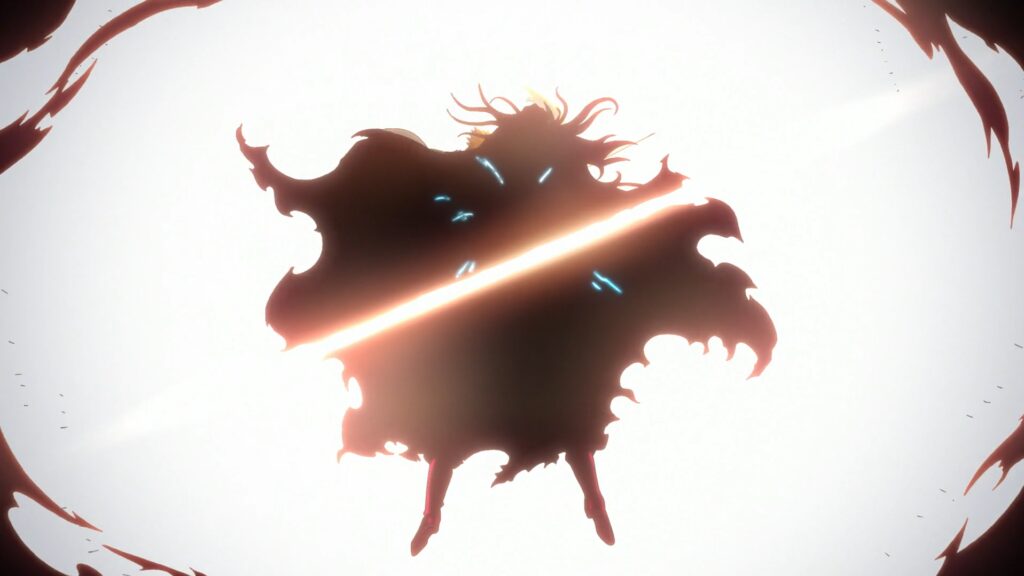
Scale brings a practical problem, though, and the production saw it coming. Yhwach is drawn mostly in black, and with versions of him appearing in three realms at once, the shots could easily have blurred together. Production comments reported by Anime Art Magazine say the team gave each appearance slightly different highlight colours so they stay distinguishable in motion. It is a fix for a problem a manga page never had to solve, and it shows the battle across three realms was planned around what a viewer can actually follow.
Ichigo and Uryu keep it personal

A finale this large lives or dies on whether its people stay visible, and the relationship carrying most of that weight is Ichigo and Uryu. The official synopsis has Ichigo learning Uryu’s true intentions and the two renewing their determination to protect the world together, as friends who trust one another. Putting a strained friendship at the centre of the war’s last stretch is the right instinct. It gives the audience something smaller than the world to hold on to while the world is at stake.
The handling of Uryu’s material points the same way. Director Hikaru Murata has said that Episode 46, THE END, deliberately returns to the manga’s storyline and keeps a key scene between Uryu and Haschwalth as it was, because the original already worked. That is a confident decision. It trusts the strongest emotional material to carry itself instead of dressing it up.
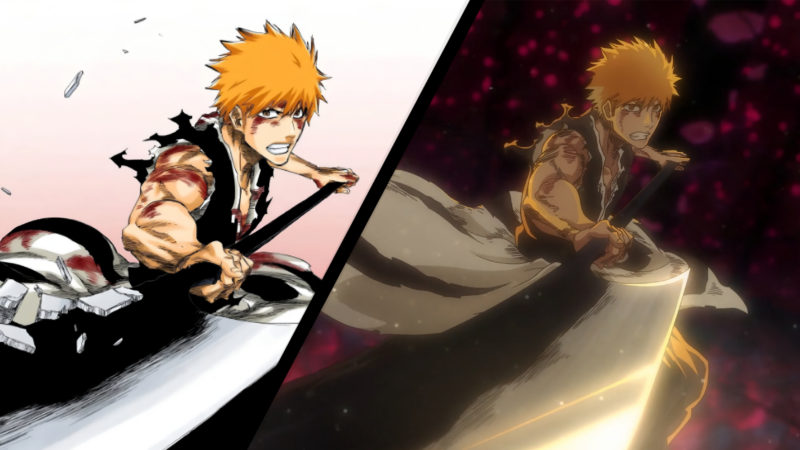
Ichigo’s own place in a shared climax gets similar attention. Tite Kubo reportedly asked for the order of a late run of strikes across the three realms to be changed so that Ichigo’s blade lands first, and the team changed it accordingly. It is a small adjustment, but when a climax is crowded with characters, the order of events decides whose moment it feels like. This one puts the emphasis where Kubo wanted it.
New material with a reason behind it
The adaptation’s approach to original content is to add where there is room and preserve where the source already works. Episode 45, DEFEND YOU, is built entirely from new scenes around an Orihime storyline. ORICON reports that Kubo is consulted on proposed additions and that his main question is whether he ever considered something similar while writing the manga. The Orihime storyline came from an idea he had. In a separate Hypebeast interview, he said he wanted fans to get more than a direct adaptation, including material he left out of the manga or could not fully depict.
The production clearly put weight behind the episode. Chief director Tomohisa Taguchi wrote, storyboarded and directed it himself, and the producer has described aiming for smooth movement and lip sync with a cinematic feel. That is a lot of ambition riding on new material, which makes the join with Episode 46 the delicate part. Voice actors have discussed how much emotion to bring to the new scenes that lead into the ones taken from the manga, so the handover was clearly on the production’s mind.
The logic holds up. Additions arrive with a stated reason instead of reading as filler, and the scenes that already worked were left alone.
Where the finale is stretched

The pressure point is Episode 49. It carries the final confrontation: three realms, a large cast and a villain at the peak of his power, all inside one episode. Episode 50, DEATH & STRAWBERRY, then jumps ten years ahead to a Soul Society that is still rebuilding. Giving the aftermath a full episode is a good sign, because it treats the consequences of the war as part of the story instead of a footnote after the last fight. It also means the climax cannot borrow time from the ending. Everything Ichigo, Uryu and the wider cast need before the time skip has to fit into that single episode.
That squeeze matters most for the thread the finale has bet on. The reconciliation between Ichigo and Uryu needs to register between the battles, not only inside them, and a cast this large cannot all receive full resolutions in that time. The synopses put Ichigo and Uryu first, which looks like the right priority, but it inevitably leaves less room for everyone else. The time skip has its own job too: show what the war cost and what has changed, all within one episode.
The Calamity Review Verdict
The Calamity delivers a finale with the right priorities. It sizes the battle to the threat, anchors the war in Ichigo and Uryu’s friendship, adds new material for stated reasons and gives the aftermath an episode of its own. The cost of that design is room: one episode carries the final confrontation, and a finale this crowded has to choose whose moment gets the most time.
Viewers who have followed the war to the end and want the closing stretch to reward the wider cast and the bond between Ichigo and Uryu as much as the spectacle will find a finale built for them. Anyone hoping for one clean duel to settle everything may find the ensemble approach busier than they want. Either way, the choices behind it are sound, and a finale that cares about its people as much as its power levels is a satisfying way to close the Blood War.
Sources: https://www.viz.com | https://bleach-anime.com | https://www.tv-tokyo.co.jp | https://www.oricon-group.com | https://hypebeast.com | https://animeartmagazine.com | https://thetv.jp