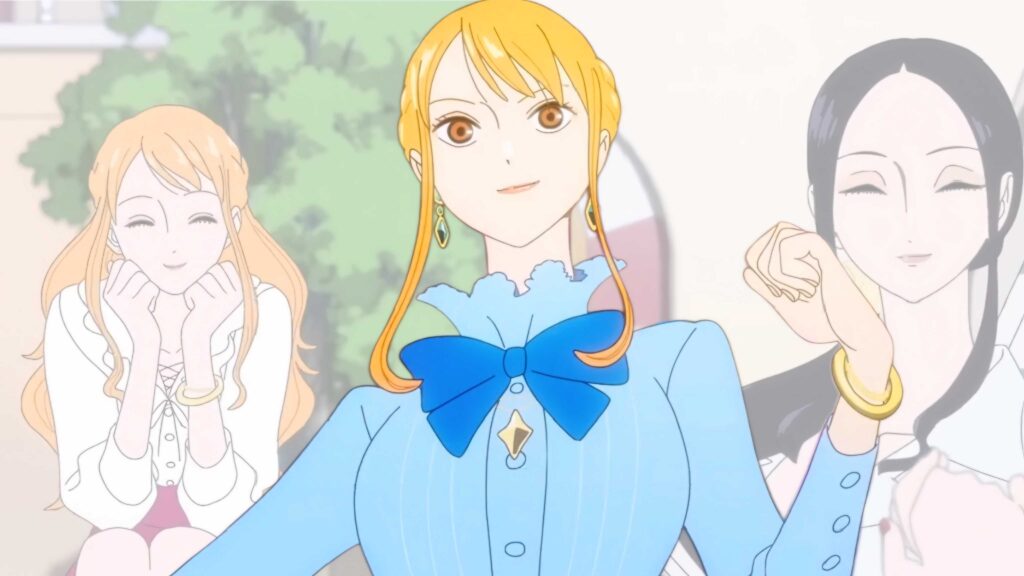
Nami has been in One Piece for almost 30 years and she has never once had an episode that was just about her. Not a flashback wedged into a war, not a training arc, just her, on her own terms. Toei’s One Piece Heroines special finally gives her that, adapting the fashion focused Nami story from Jun Esaka’s spin off light novel. It aired in Japan on July 5, sitting in the show’s normal Sunday slot, with a worldwide Netflix release following on July 11. No Straw Hat war. No treasure. Just Nami, a pair of shoes that betray her, and a question the title of this review is built around: is this finally where Oda’s female cast gets the space the weekly manga schedule never gave them?
Quick Story Breakdown
The premise sounds almost aggressively small for a franchise built on world ending stakes. Nami buys a pair of shoes. They hurt her feet. She goes back to the shop to complain, and gets pulled into the orbit of Lebno Listchaque, a celebrity designer who wants her to model his new line, and Miucha, the quiet shoemaker who actually does the work Lebno takes credit for. What starts as a customer complaint turns into a fashion show heist, a bit of light crime, and a lesson about who really deserves the spotlight in a business built on somebody else’s labor. It is a story about clothes on the surface. It is a story about being seen for what you can do, not what somebody markets you as, underneath.
Production Rundown:
Direction: Haruka Kamatani, whose earlier credits include Looking for Magical Doremi and Koisuru One Piece. Her fingerprints are all over the softer, quieter visual grammar here, and it shows.
Character Design and Animation Lead: Takashi Kojima, known for The Colors Within and Flip Flappers. He brings a level of linework restraint that One Piece almost never uses on its own characters.
Script and Screenplay: Momoka Toyoda, who previously wrote One Piece Fan Letter and worked on the edited Fish Man Island Arc special. She has clearly done this kind of side story work before and it reads in the pacing.
Original Source Material: episode NAMI, the first chapter of the One Piece novel HEROINES, written by Jun Esaka and illustrated by Sayaka Suwa, first published under Shueisha’s Jump J Books imprint in 2021.
Notable Voice Cast: Maaya Sakamoto as Miucha, and Takehito Koyasu, the actor behind Doflamingo, as Lebno. Casting the voice of one of One Piece’s most theatrical villains as a preening shoe designer is a wink only longtime fans will catch, and Koyasu clearly knows it.
Narrative Structure and Pacing
A 24 minute special does not have room to waste, and this one does not waste much. The episode opens with an anime original addition not found in the source novel: pirates in Lebno’s employ ambush Nami’s ship and steal her jewelry, and her shoes fail her mid chase. That single sequence does more work than any amount of narration could. It gives the special a reason to exist as television rather than an illustrated audiobook, and it sets Nami’s personal stake, getting her stolen treasure back, before the fashion world plot even starts.
From there, the pacing settles into a rhythm that feels closer to a heist caper than a typical One Piece episode. Setup, infiltration, reveal, payoff. It never drags, though there is a small stretch in the middle, Nami and Miucha’s fitting scenes, that leans on mood over momentum. That is a deliberate choice more than a flaw. Quiet scenes need room to sit.
Direction, Animation, and Visual Presentation
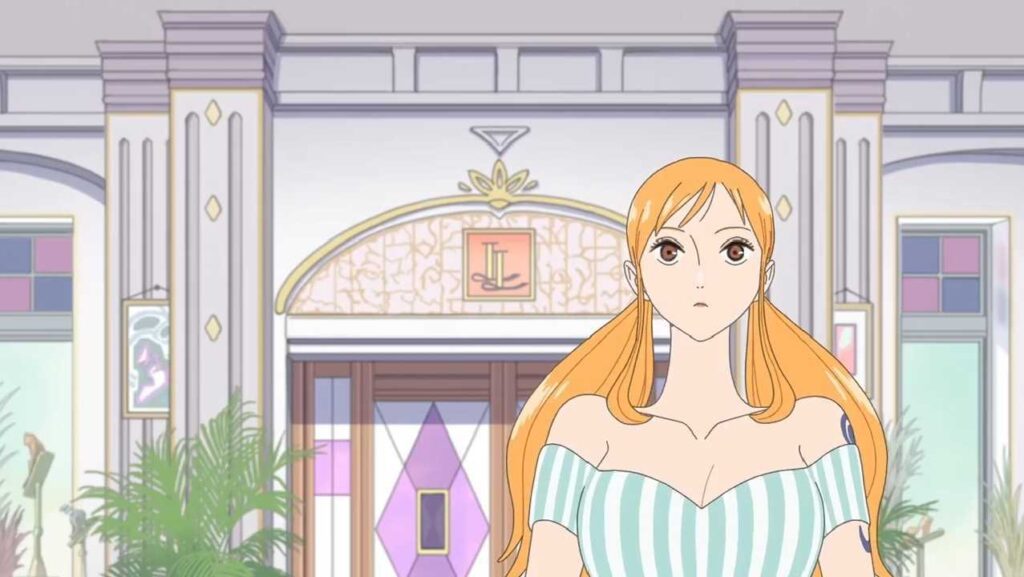
This is where the special actually earns its own identity, and where Kamatani’s direction is doing the heaviest lifting of the whole project. One Piece the weekly series lives on volume: big impacts, big expressions, big color blocking meant to read clearly at broadcast speed. Heroines throws almost all of that out. CBR’s coverage of the first trailer noted a noticeably different visual style from the main anime, with softer character designs, richer backgrounds, and a much stronger focus on fashion and everyday life instead of the usual action driven animation. That description undersells how far the shift actually goes once you watch the finished episode. Wikipedia
Kamatani frames ordinary objects like they matter. A shoe on a workbench gets the same careful composition most anime save for a legendary sword. A length of fabric catching light in the workshop becomes its own small piece of visual storytelling, telling you Miucha’s skill before a single line of dialogue confirms it. The color work leans pastel and warm rather than One Piece’s usual primary color punch, and that softness is not decorative. It is the entire argument of the episode rendered visually: this is a story about care and craft, not conquest, so the frame should feel like it too.
Kojima’s character design work is doing something similarly deliberate. Fans who know his work on Flip Flappers and The Colors Within will recognize the same expressive restraint here, faces that hold a beat longer than a shonen action scene ever would, small physical gestures given real weight. Fashion, in this episode, is not fan service. It is used the way costume design is used in a prestige drama, as characterization. Lebno’s shows change with his artistic sense; Miucha’s shoes are practical, functional, an extension of a person who cares more about whether something works than whether it photographs well. The episode is arguing a whole thesis about authenticity versus commercialism through footwear, and it mostly gets away with it because the direction never winks at how absurd that sentence sounds.
If there is a flaw here, it is that the softer palette occasionally flattens the action beat during the runway confrontation. Nami’s Clima Tact bubble and steam trick, used to cover Robin’s theft, reads a little muted compared to how the main series would stage the same gag. That is a fair trade for everything the visual restraint buys the rest of the episode, but it is worth naming.
Character Writing and Performances
Forget growth arcs here. Nami and Robin are both fully formed, established characters, and the special wisely does not pretend otherwise. What it does instead is give them room, specifically room away from Luffy and the rest of the crew, which is rarer for these two than it should be after a thousand plus episodes.
Nami spends this episode almost entirely defined by agency rather than reaction. She is not rescuing anyone from a villain twice her size. She is reading a business relationship correctly within minutes, recognizing that Miucha, not Lebno, is the real talent in the room, and deciding to act on that recognition without needing anyone’s permission first. ANN’s review of the episode pointed out that Nami has spent years at the mercy of men who would not let her chart her own course, and that recognition is exactly what lets her see Miucha’s situation for what it is. That is a sharp piece of characterization, using Nami’s Arlong era history as unspoken context rather than restating it.
Robin gets less screen time but a stronger punchline. Her addition to this story is an anime original choice, not something pulled from Esaka’s novel, and it works because Robin’s dry, competent criminal streak is the perfect complement to Nami’s more emotionally invested plan. The two of them operating as a two woman heist crew, with zero input from the men on the ship, is exactly the kind of female camaraderie longtime readers have wanted more of.
Miucha is the episode’s real find. Sakamoto plays her with a kind of quiet exhaustion that never tips into melodrama, a woman who has convinced herself that her boss’s name matters more than her own hands. Koyasu, opposite her, is doing exactly what you would expect the voice of Doflamingo to do with a role like Lebno: big, theatrical, entertainingly punchable. ANN’s review singled out his performance as one that tears up the scenery in the best way, and that is not an overstatement.
Audio Design and Soundtrack
Aina the End provides the theme song, confirmed through Anime News Network’s coverage of the trailer in late June. It fits the episode’s tone far better than a typical One Piece opening would, leaning melodic and a little wistful rather than triumphant. The rest of the score stays largely in the background, letting quiet room tone and small sound cues, a needle through fabric, the click of a shoe heel on a runway, carry scenes that would otherwise rely on dialogue. It is a subtle choice, and one that supports the visual restraint rather than competing with it.
Psychological Stakes and Themes
Underneath the fashion show plot is a much more grounded idea: what happens to a talented person when they let someone else’s name become bigger than their own work. Miucha is not oppressed by a villain in the traditional One Piece sense. She is oppressed by her own belief that Lebno’s approval is worth more than her own competence, and that is a far more relatable trap than any pirate warlord.
Nami’s involvement reframes that trap without lecturing about it. She has lived a version of this, being controlled by someone who profited off her skill while convincing her she had no other option, and the episode trusts the audience to remember Arlong Park without spelling it out. The theme lands as women recognizing the same cage in each other and refusing to accept it as permanent, which is a more mature piece of writing than a lot of One Piece side material bothers with.
Genre Execution and Series Evolution
This is the question the whole review is built around, and the honest answer is yes, with a caveat. The timing here is not an accident, since this special landed right as the main series had been running the Elbaf Arc, one of the loudest, most battle dense stretches of the entire franchise. Heroines using that same weekly broadcast slot means fans who tuned in expecting another chapter of that war got something deliberately, almost defiantly quiet instead.
That contrast is exactly why the franchise needs pieces like this. One Piece has always had more female characters worth exploring than its weekly page count allows, Nami, Robin, Vivi, Hancock, Perona, all of them carrying histories the main manga only gets to visit during major arcs, if at all. A vignette format, freed from the pressure of moving the central plot forward, lets Oda’s world breathe in a register the flagship story rarely permits itself. It is intimate where the main show is loud, domestic where the main show is operatic, and that is not a weakness. It is the entire point.
The caveat: one 24 minute episode about shoes is a proof of concept, not a movement. Robin, Vivi, and Perona all have stories waiting in the same novel collection, and no broadcast schedule for them has been confirmed yet. Whether this becomes a recurring feature of the franchise or a one off experiment depends entirely on what Toei does next.
Adaptation Quality: From Page to Screen
Adapting a light novel is a different problem than adapting a manga. There are no panels to reference, no existing visual language, just prose, internal monologue, and description. In Esaka’s original chapter, a large amount of the story lives inside Miucha’s head, her private thoughts about class, privilege, and why she keeps deferring to Lebno despite resenting him for it. None of that translates directly to screen, and the production made some genuinely smart choices to compensate.
The biggest change is structural. The anime added an entirely new opening heist sequence, with pirates working for Lebno stealing jewelry from the Straw Hats, something that does not exist in the novel at all. That is a smart translation choice. It turns an introspective character study into something with visual stakes from minute one, without changing what the story is actually about.
The bigger swing is the ending. Esaka’s novel closes on a clean, hopeful note, with Miucha finding the courage to start making shoes under her own name after Nami’s encouragement. The anime instead replaces the novel’s quieter resolution, where Miucha simply hands Nami a key to the shop, with a full chandelier heist during the fashion show itself, and ends on Robin asking Nami whether she regrets leaving without saying a proper goodbye. That is a genuinely different emotional note than the source material chose, less about Miucha’s personal triumph and more about the bittersweet nature of pirate life, you help someone, then you sail away before you get to see what they become. It is a better fit for who Nami and Robin actually are as characters who never get to stay anywhere long. Anime only viewers will not feel lost missing this distinction, but readers of the novel will notice the tonal shift immediately, and it is worth knowing this was a deliberate choice, not a simplification.
Cameos worth catching:
The episode opens on an action tease before Nami’s story even starts, and it never once confirms a face. A shadow rises with just Luffy‘s hat visible as he calls out Gum Gum Battle Axe, a string of unattributed slash attacks reads unmistakably as Zoro, a swirl of fire inside the Sunny arrives with Sanji‘s voice calling Diable Jambe over it, and a wall of plant growth trapping the fleeing pirates can only be Usopp. Chopper, Brook, Franky, and Jinbe do not get so much as a nod in the same stretch. Perona gets the other blink and you will miss it cameo, passing by Lebno‘s empty storefront after his arrest in the closing minutes. None of it matters to the plot. All of it is a nice reward for paying attention.
Viewer Recommendation
Recommended if you are a longtime Nami or Robin fan who has wanted material centered on them without a battle attached, if you appreciate anime that treats costume and craft as storytelling rather than decoration, or if you have any interest in how a prose only light novel gets reimagined for television.
May not work if you came to One Piece purely for large scale fights and expect that from every piece of content wearing the name, or if 24 minutes about a fashion show sounds thin no matter how it is executed.
Final Verdict
The biggest strength here is confidence. Kamatani, Kojima, and Toyoda commit fully to a visual and tonal register One Piece almost never uses on itself, and the result feels like a genuine expansion of what this franchise’s side material can be, not a watered down filler episode wearing the brand. The biggest weakness is scope. One episode about one heroine cannot answer the bigger question of whether Toei is serious about giving Oda’s women this kind of space long term. As a standalone experience, though, this is some of the most purposeful visual storytelling One Piece has produced outside the main weekly series in years, and it genuinely does feel like the backstory beat Oda never had room for on his own schedule.
Final Score: 8/10
Looking Ahead
With Robin, Vivi, and Perona‘s chapters from the same novel still unadapted, this feels less like a one time experiment and more like a pilot for a format Toei could return to. Whether that happens depends on how this one performs.
Is One Piece Heroines canon to the main story?
Yes. It adapts an officially licensed light novel chapter set in the same universe, with an anime original addition of Nico Robin to the story, and it is treated as canon side material rather than a non canon parody special.
Where can I watch One Piece Heroines?
It aired in Japan on Fuji TV on July 5, with Crunchyroll carrying a same day simulcast, and Netflix adding it for international audiences on July 11.
Will there be more One Piece Heroines episodes?
Nothing is confirmed yet. The source novel includes unadapted chapters focused on Robin, Vivi, and Perona, so more episodes are possible, but no broadcast date has been announced for any of them.
Does One Piece Heroines connect to the Elbaf Arc?
Not directly. It aired in the same weekly broadcast slot the Elbaf Arc normally occupies, functioning as a one week detour rather than a story that ties into Elbaf’s plot.
Sources: Anime News Network | CBR | Crunchyroll | One Piece Wiki