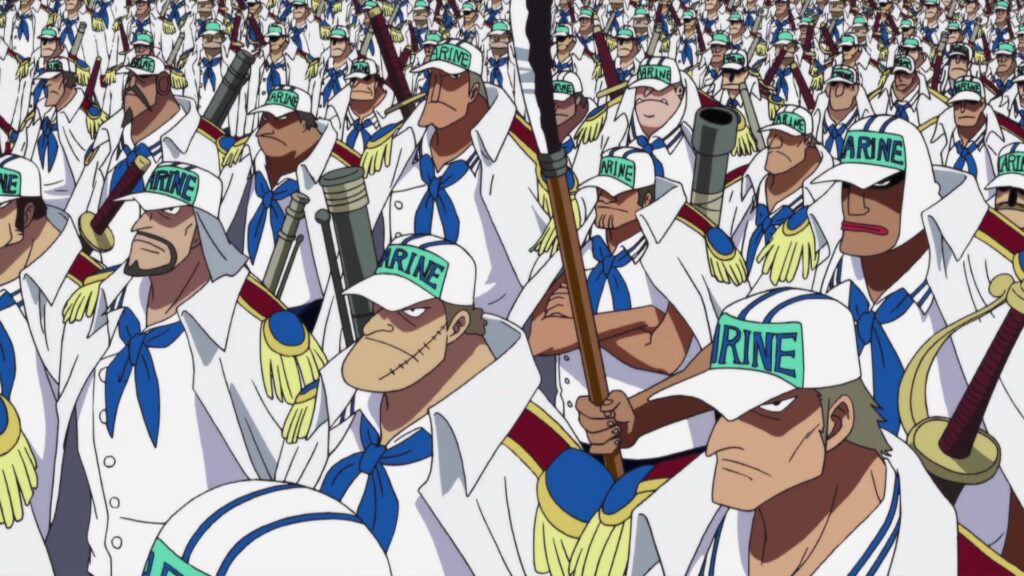
Every big Marine moment in One Piece comes with an admiral throwing a punch that levels half an island, or Marineford’s cannons lighting up the sky. That’s the show. What almost never gets airtime is everything underneath it: who pays for the bullets, who builds the battleships, who feeds the soldiers standing behind Garp, and who patches up the ones who get sent home broken.
Oda has never sat the audience down and explained how the One Piece Marines actually work behind the scenes. But across well over a thousand chapters, he’s dropped enough pieces (Water 7’s shipwrights, the Heavenly Tribute, a Den Den Mushi call reaching across an ocean) to piece the shape of it together. What follows isn’t a guess dressed up as canon. It’s what the manga actually shows about how an organization this massive keeps functioning every day, and where the cracks start to show.
An Ocean Full of Problems
The Grand Line alone holds hundreds of islands, and that’s before counting the Four Blues, Fish Man Island, and everything past the Red Line in the New World. The World Government claims affiliation with more than 170 nations, and Marine Headquarters is supposed to keep some kind of presence protecting most of them.
The chain of command runs from Chore Boys, the lowest rank in the Navy, up through Ensigns, Captains, Commodores, Rear Admirals, Vice Admirals, the three Admirals, and finally the Fleet Admiral. A single Buster Call, the Marines’ most extreme option for wiping an island off the map, requires at minimum five Vice Admirals in the fleet. That’s not five soldiers. That’s five of the most dangerous people in the organization pulled off whatever they were doing for one mission.
Then there are the branch bases scattered everywhere. G5, a single outpost in the New World, runs with roughly 300 personnel split across six units, and the story treats it as one of the rougher postings in the whole force. Multiply that staffing across every numbered branch from the East Blue to the New World, and the Marines stop looking like a police force and start looking like the largest standing military the story has.
Where the Belly Actually Comes From
The money for all of this has to come from somewhere, and the manga is fairly direct about it. Every nation affiliated with the World Government pays the Heavenly Tribute, a tax calculated by population size that funds the Celestial Dragons’ lifestyle in Mary Geoise. It plays out less like a national defense budget and more like a protection racket. Pay up, and the Marines and Cipher Pol defend you. Fall behind, and you’re on your own against pirates.
What the story doesn’t spell out is the exact accounting split between funding the Navy and funding the Nobles’ excess. That connection, Marine ships, weapons, and payroll drawing from the same tribute system that bankrupts poorer kingdoms, is never stated outright. It’s the most reasonable explanation available given that Cipher Pol, Impel Down, and the judiciary at Enies Lobby all answer to the same central treasury. Call it a strong inference, not a confirmed fact.
The Shipyards Behind the Fleet
Somebody has to build the battleships, and this is one part Oda actually answers on page. Water 7’s shipwrights, organized under the Galley La Company after Iceburg merged the island’s rival docks into one massive operation, primarily build for civilians and the World Government alike. While the free trade city handles commerce neutrally, Galley La does not openly contract with pirates, frequently fighting off outlaws who cause trouble in the docks. Furthermore, Franky’s backstory shows him independently constructing armed warships, nicknamed the Battle Frankies, as a personal hobby out of scrap metal, a dangerous obsession that eventually led to his mentor Tom being framed by the World Government using those very same ships.
Marine battleships are fitted with Sea Prism Stone coated hulls, a technology that enables safer travel through the Calm Belt, which hides them from Sea Kings and lets them cross the notoriously deadly Calm Belt without becoming lunch. The catch is that Sea Prism Stone is rare, and its finest craftsmen are in Wano Country, a nation that spent most of the story sealed off from the rest of the world. That’s a supply bottleneck hiding in plain sight. The material every Marine ship depends on for safe passage was, for a long stretch of the series, sourced from a country the Marines couldn’t even enter.
Feeding and Arming an Army the Manga Rarely Shows
This is the part Oda has genuinely never drawn: who’s growing the food for a base of hundreds of Marines in the New World, and how it gets there. What the story does confirm is that Rear Admirals command Marine forces and oversee regional operations, while the daily grind of maintaining bases and equipment falls heavily on the lower ranks. Chore Boys, the entry rank Koby and Helmeppo both started at, exist for exactly this kind of unglamorous labor.
The weapons side is clearer. Sea Prism Stone turns up worked into handcuffs, jail cells, jitte, and full weapons, which means someone inside the Marine supply chain is manufacturing and distributing a material rare enough that entire criminal networks have tried stealing it. Any base holding a Devil Fruit user in custody needs a steady stock on hand, so Marine logistics, at minimum, includes a working pipeline for one of the rarest resources in the setting.
The Infirmary Nobody Talks About
Marine medical care barely gets screen time, but it isn’t invented out of nothing either. Marineford itself is shown with a dedicated infirmary among its facilities, sitting alongside the control room and the Admirals’ offices. What field medicine looks like at a remote branch base is left to the reader’s imagination, but headquarters level care clearly exists as a built structure rather than an assumption.
Given how often Vegapunk’s research bleeds into everything else the Marines use, from Pacifista to those Seastone hull coatings, it wouldn’t be a stretch to guess some of that same research touches Marine medicine too. That part is inference, not confirmed on page. What is confirmed is that Marineford underwent extensive reconstruction after the Summit War, with repairs continuing during the story’s post war period. This means the organization’s actual capacity to rebuild its infrastructure is something the story has put a real timeline on, proving how quickly the Marines can structurally bounce back after a catastrophic defeat.
The Snail Network Holding Everything Together
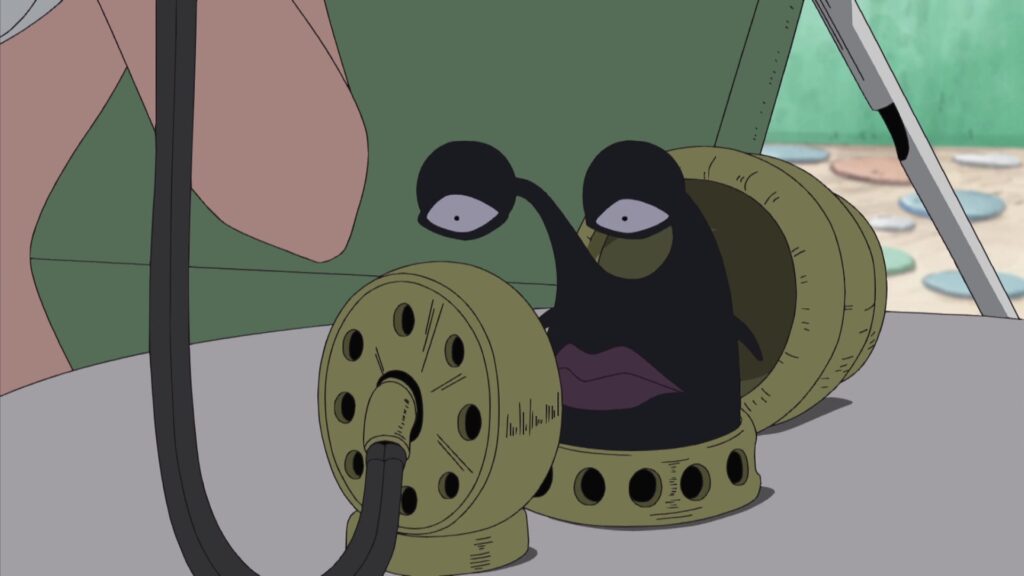
If there’s one piece of Marine infrastructure Oda has fully thought through, it’s this one. The Den Den Mushi network works as the telephone, internet, and fax machine of the setting rolled into a single living creature, and the Marines lean on specific variants for specific jobs. Black Den Den Mushi are deployed as covert wiretaps to intercept outlaw communications. Meanwhile, Golden and Silver Den Den Mushi exist purely to trigger a Buster Call, with the Golden snail sending the destructive order and the Silver one screaming a base wide alarm at the receiving end.
That’s how Marine Headquarters can learn about a Yonko sighting in the New World and have five Vice Admirals moving within the same chapter. Wanted posters and bounty updates travel through some version of this same network too, even though the manga never spells out the exact printing chain behind a poster reaching a small East Blue town. By the Egghead arc, Vegapunk had already pushed the tech further with a Transmission Den Den Mushi that broadcasts without needing another snail on the receiving end and can’t be jammed. Out of everything covered here, the information side of Marine logistics is the one Oda has clearly worked out down to the details.
Where the System Actually Breaks
The cleanest proof that Marine logistics has limits is what happens at the edges. Nations that can’t pay the Heavenly Tribute lose Marine protection outright, and the story treats this as a routine, ongoing failure rather than a rare exception. No tribute means no ships showing up when pirates raid the coast.
Resourcing inside the organization itself isn’t even either. G5 is described within the story as one of the roughest Marine bases in the Navy, full of discipline problems and a reputation for cruelty that outsiders like Smoker had to actively push back against. The Marines also maintain a permanent Inspector General position, whose entire job is investigating corruption and mismanagement inside the ranks. An organization doesn’t build a standing watchdog role unless the thing it’s watching for actually happens on a regular basis.
Marineford is the biggest example of all. After the Summit War tore the island apart, rebuilding it took roughly two years, all while the rest of the Marine machine kept running short an Admiral, its most decorated Vice Admirals scattered across different assignments, and its own headquarters sitting in visible ruins for the world’s press to photograph. Logistics can absorb a lot. It can’t absorb everything at once.
The Real Strength of the Marines
Every admiral fight looks like the whole story, but it isn’t one. Behind Akainu’s fist or Kizaru’s light is a supply line running back through a Water 7 dry dock, a Heavenly Tribute payment squeezed out of some small kingdom, and a Den Den Mushi operator who picked up on the first ring. Oda has never drawn a flowchart for any of this, but he’s left enough on the page for anyone willing to look.
The One Piece Navy doesn’t function because three Admirals are terrifying. It functions because thousands of Marine soldiers nobody ever names are keeping ships fueled, wounds stitched, and snails ringing, across an ocean that never stops trying to swallow the whole operation whole.
How does the World Government pay for the Marines?
The World Government funds itself mainly through the Heavenly Tribute, a tax paid by every affiliated nation and calculated by population size. The manga does not break down the exact split between funding the Navy and funding the Celestial Dragons directly, but both draw from the same central treasury.
What is Sea Prism Stone used for by the Marines?
Sea Prism Stone, also called Seastone, nullifies Devil Fruit powers on contact and is worked into handcuffs, jail cells, weapons, and the undersides of Marine battleships. Its main known source is Wano Country, which spent most of the story cut off from the rest of the world.
How do the Marines communicate across such long distances?
The Marines rely on Den Den Mushi, a species of telepathic snail used as living telephones. Specific variants handle specific jobs, including Black Den Den Mushi for classified traffic and the Golden and Silver pair that exists solely to trigger a Buster Call.
Why do some islands have no Marine protection at all?
Nations that cannot afford the Heavenly Tribute are not accepted into the World Government, and unaffiliated islands do not receive Marine defense against pirates. The manga treats this as a routine and ongoing gap in the system rather than a rare exception.