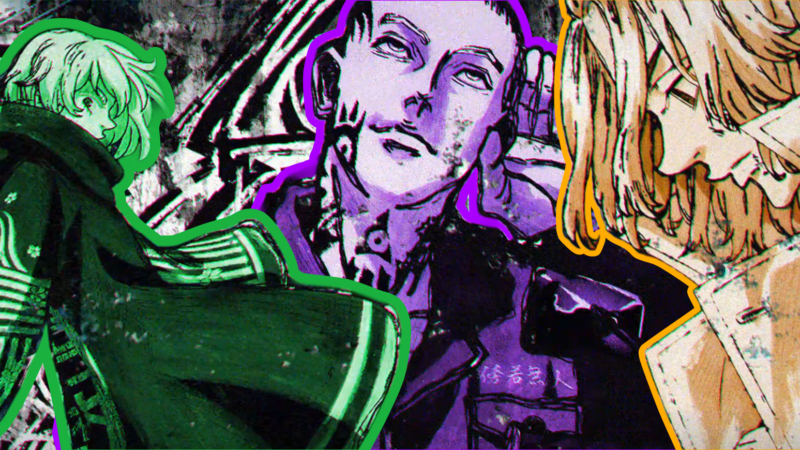

He can flatten almost anything put in front of him, and that’s the problem this series finally decides to face. This That Time I Got Reincarnated as a Slime Season 4 review comes down to one shift: the show quit asking whether its hero can win and started asking what winning would cost. It’s a small change of question with large consequences, and it gives these episodes a confidence I didn’t expect.
Across That Time I Got Reincarnated as a Slime Season 1 and That Time I Got Reincarnated as a Slime Season 2, Rimuru built a shelter for monsters with nowhere safe to go, and the stakes climbed from survival to standing up to Demon Lords. When the new episodes began on April 3, 2026, per the official Tensura site, that shelter had become a country, and a country needs a different kind of leader.
The Labyrinth Episodes Are Comedy With a Job to Do
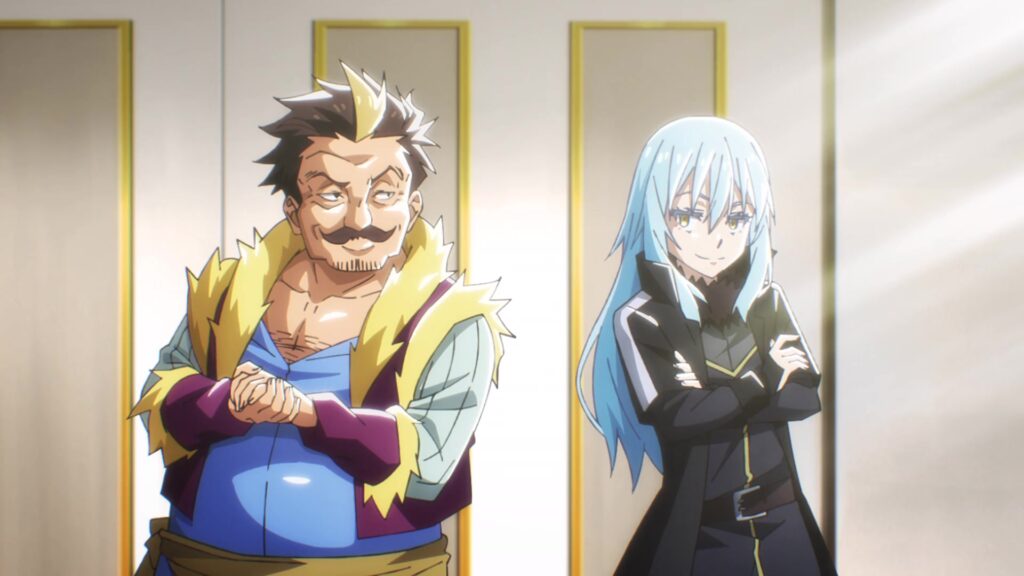
The opening episodes start at a complaints desk. Adventurers argue with Benimaru’s security team because the Labyrinth is too hard for ordinary people, and the grievances land on Rimuru. His fix, built on Masayuki’s game minded advice, is rest areas and a prize worth advertising. It works, until a hundred person party called Team Green Fury arrives and the problem flips.
The payoff is “The Avatar Team Is Formed,” where Rimuru, Ramiris, Veldora and Milim squeeze into limited bodies and lose badly. Four of the strongest beings alive can’t function as a party, which is funny on its own. It also exposes something about a ruler who has always been surrounded by people who solve problems with force. The humiliation is the lesson: strength doesn’t coordinate itself.
Compared with the meeting heavy episodes of That Time I Got Reincarnated as a Slime Season 3, the balance here is a real improvement. The jokes plant ideas the politics harvest later, so when the talking starts it feels like a payoff rather than homework.
A Demon Lord Versus a Rulebook
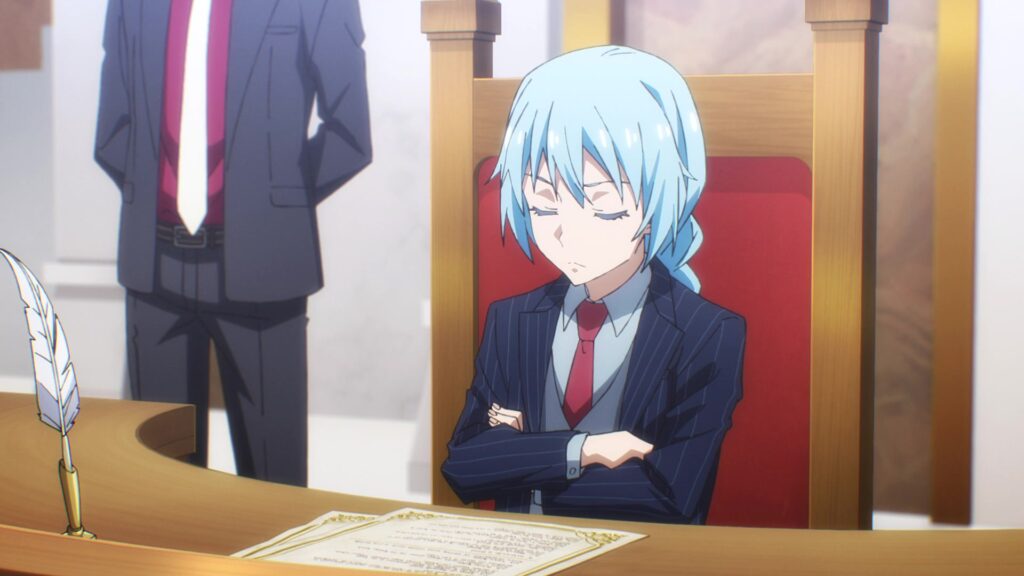
Episode four, “Invitation,” sends him toward the Western Nations Council in Engrassia. The third episode has already cut away to Mariabel Rozzo in the Kingdom of Siltrosso, who sees his rising influence as a danger. Nothing in that setup has fangs. The threat is procedure, and his usual answer doesn’t apply.
Here’s the idea I think the whole run turns on: power can win a fight, but it can’t earn trust. He’s one of the most dangerous person in any room he enters, yet flexing would prove his opponents right, so every provocation asks him to be gentler than the people who fear him. That’s an uncomfortable position for a character whose default solution is overwhelming force, and the writing, under Hitomi Ogawa’s series composition, gets its best tension from making him sit in it.
It also reframes the Labyrinth. A broken dungeon taught him to read a system ordinary people couldn’t use, and the Council asks him to read one built by people with their own interests. The skill carries over, and that’s when patience, not strength, becomes the main event.
Tempest Grows Up

Two scenes show how far the country has come. In one, Rimuru visits a newly built school where Chloe and other children study beside young monsters, and the official synopsis frames Tempest as a nation starting down the path of law. In the other, Diablo goes down into the demon realm and recruits three Primordials, Yellow, Violet and White, through words and force. The cast list points to Testarossa, Ultima and Carrera as the result.
Side by side, they hold the show’s best trick. The classroom is the future he wants, where nobody cares which species sits at the next desk. The recruitment is the price of protecting it, because a country that children can trust also has to be one the ancient powers respect. He thinks of naming as a friendly gesture, while the world sees a superpower arriving, and that gap is where the tone slides from cozy to unnerving.
By episode 96 the run has passed through workplace comedy, political thriller, a conspiracy with several fronts and a fourth mode I refuse to describe. A music festival hosted by Luminus in Lubelius opens that door, and that’s all I’ll say.
Where It Stumbles
The Lubelius episodes intercut several confrontations at once, and each time one fight nears an answer, the show jumps to another. That’s tension by scheduling. It keeps the pulse up, but no single duel gets the room it needs to say anything, which is a shame for a series that’s been so patient elsewhere.
The avatar gag overstays a little as well. The idea that Rimuru’s friends break every scale of measurement appears in the second episode, returns in the third, and is still running in the fourth before the plot moves on.
Season Four Production Lineup
- Direction: Naokatsu Tsuda, with Kenji Yasuda as assistant director and Atsushi Nakayama as supervisor. Swinging from office comedy to conspiracy takes one steady hand, and this holds together.
- Script and Composition: Hitomi Ogawa. The handoff from dungeon jokes to Council politics is a writing choice, and it lands.
- Character and Monster Design: Ryoma Ebata and Takahiro Kishida. Labyrinth guardians are both the joke and the threat, so monster design does double duty.
- Animation Production: Eight Bit, with Masayori Komine, Hideki Yamazaki and Tomoko Ito as chief animation directors.
- Photography and Compositing: Hiroshi Sato is credited as 撮影監督, the director of photography. In Japanese TV anime that means the compositing stage where drawings, backgrounds, effects and CG merge, not a camera operator.
- Effects and CG: No single special effects supervisor is credited. Hironori Morino is CG director and Yuji Haibara is graphic designer, so demon realm imagery and large scale magic come from several departments working together.
- Color and Art: Maki Saito on color design, Ayumi Sato as art director, Studio Naya on art.
- Editing and Sound: Yumi Jinguji edits, Jin Aketagawa directs sound and R・O・N composes. Editing carries the most weight in the Lubelius stretch, where the intercutting is both the ambition and the problem.
That Time I Got Reincarnated as a Slime Season 4 Review: Who Should Watch
If you love the dungeon and nation building side of the series, this is built for you. If you only tune in for duels, be patient, because the show cares more about what power is for than about who has more of it. Newcomers should start at the beginning, since these episodes lean on a lot of shared history.
That’s the short version of this That Time I Got Reincarnated as a Slime Season 4 review: two confident, funny, politically sharp cours that trust kindness over strength, and are better for it. Episode 96 closes the second cour, and the official site announced on September 25, 2026 that the third is scheduled for July 2027. Anyone already looking ahead to That Time I Got Reincarnated as a Slime Season 5 has to sit through that first.
When did That Time I Got Reincarnated as a Slime Season 4 premiere?
According to the official Tensura site, Season Four began on April 3, 2026. Its episodes are numbered from 73 onward across the whole series.
How many episodes has Season 4 aired so far?
The official numbering runs from episode 73 through episode 96, which makes 24 episodes across two cours. The site announced on September 25, 2026 that the third cour is scheduled for July 2027.
Who directed That Time I Got Reincarnated as a Slime Season 4?
Naokatsu Tsuda is credited as director, with Kenji Yasuda as assistant director and Hitomi Ogawa on series composition. Eight Bit handles animation production.
Do I need to watch the earlier seasons first?
Yes. These episodes build on what came before, including the Founder’s Festival and Rimuru’s history with Hinata, Milim and Veldora. Starting from the first season makes the political payoffs land harder.
Sources: https://www.ten-sura.com | https://www.crunchyroll.com