This article contains major spoilers for The Apothecary Diaries anime through Season 3, Episode 54. One section near the end covers light novel material the anime has not adapted. Read on only if you are caught up.
Does Maomao actually hate Jinshi? Her early scenes give plenty of reasons to think so. She finds his overly familiar behaviour irritating, treats his requests as troublesome assignments and resists his romantic advances. But what she says and what she does are not the same thing. Follow her actions across Seasons 1 to 3 and the anime shows a relationship built on professional respect, shared danger, personal trust and growing emotional closeness.
That does not mean every kind act hides romantic love. Maomao’s irritation is genuine, and she has serious reasons to keep her distance. The most convincing reading is that her feelings develop alongside her awareness of how dangerous acting on them could be.
Does Maomao Actually Hate Jinshi, or Just His Behaviour?
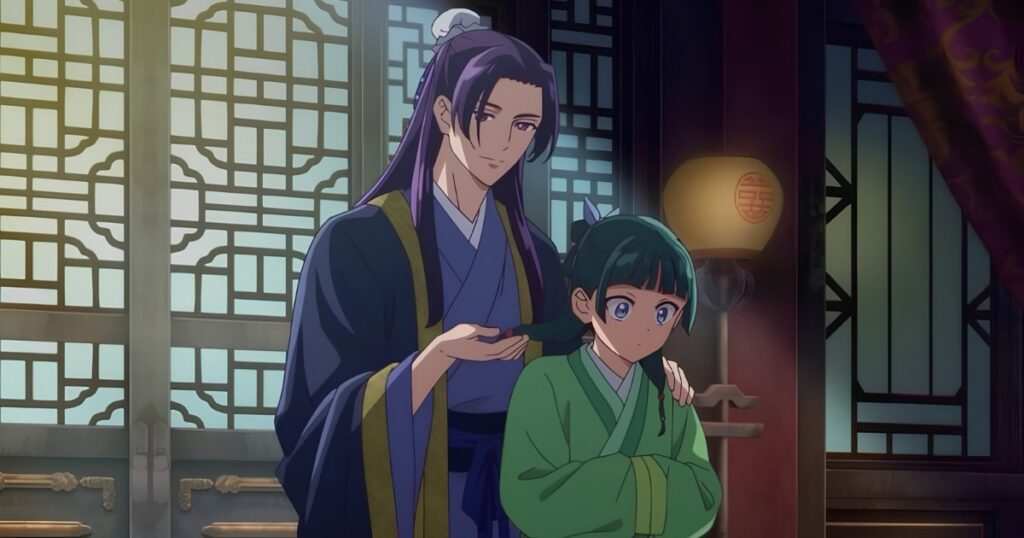
The annoyance is real, and it is not necessarily disguised attraction. Early on Jinshi uses his beauty, charm and authority to provoke reactions from her, and she refuses to react like his usual admirers. In Episode 17 she does not want to join his disguised outing at all, a reluctance captured in the line “I only have bad feelings about this.” She goes anyway and carefully disguises him, changing his appearance, scent and voice.
Obedience is weak evidence of affection. Maomao is subordinate to Jinshi, and refusing a powerful official can have consequences, so finishing his assigned work in Episode 2, including preparing an aphrodisiac, shows professionalism. Irritation is not hatred either. Episode 24 establishes that she can separate disliking someone from hating them, even when family history is painful. She clearly dislikes her biological father Lakan’s involvement in her life, yet she acknowledges his abilities and acts on her own moral judgment. Helping someone, in other words, cannot count as automatic proof of affection.
That makes the useful question not only what Maomao does but why. The same action can come from duty, medical instinct, self protection or affection, and her relationship with Jinshi runs along professional, emotional and political lines at once.
The Acts of Service That Say More Than Her Words
Maomao keeps up a reluctant front, but she repeatedly notices what Jinshi needs, and that evidence comes in different strengths.
The weakest is the Episode 19 rescue. She pushes past a guard despite being struck and saves Jinshi from a falling structure, but she does not initially know he is the person at risk. It shows courage and medical responsibility, not devotion to him.
The hunting trip in Episode 35 is stronger. Jinshi is suffering in the heat, and Maomao notices, finds him, cools his face with a wet cloth and later urges him to eat. There is a caregiving explanation, but this is active concern, not submission to his affection.
The most revealing scenes are the ones where she could have stayed formal. In Episode 48, after the Shi Clan crisis, she inspects his stitched wound and reassures him about the scar on his face, telling him his genuine qualities matter more than his beauty. A medical check becomes an answer about who he is, not how he looks.
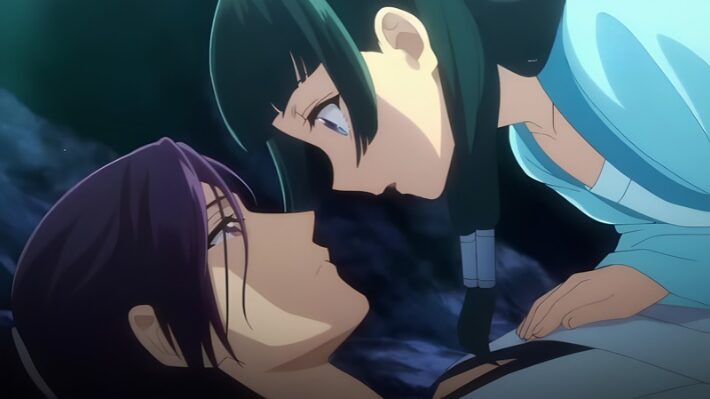
Season 3 goes further. In Episode 50 an exhausted Jinshi turns up, and Maomao tells him to rest while still teasing him. He takes her hand and asks for a lullaby, and she stays, singing until he falls asleep. He initiates the handholding, so this is not a confession from her, but it is far more domestic than their early encounters.
Director Akihiko Fudesaka said in an October 17, 2026 interview that the longer silent pauses during the lullaby were deliberate, leaving viewers room to consider thoughts neither character voices. He described the relationship as a gradual narrowing of emotional distance, not a sudden transformation.
Why She Keeps Her Distance Anyway
Closeness has not meant dropping her guard. She will examine his injuries, yet in the frog incident of Episodes 35 and 36 an accidental fall creates intimate contact and she frantically insists she touched a frog. It is comic, but it is also self preservation: the incident exposes the contradiction in Jinshi’s supposed identity as a eunuch, and she holds on to a convenient explanation instead of pressing him. When his advances later escalate into attempted kisses, she looks alarmed and tries to redirect the moment. That is boundary setting, and it cannot be counted as consensual intimacy.
Her habit of staying uninvolved explains more. Fudesaka has described Maomao as someone who generally avoids asking too much of others or becoming deeply involved with them, with the Shi Clan storyline and her friendship with Shisui as a deliberate exception. When she does choose involvement, she commits: in Episode 46 she intervenes in desperate circumstances to rescue Shisui and the children. The question may not be whether Maomao has feelings for Jinshi so much as whether she will act on feelings that could upend her life.
Rank sharpens the problem. Jinshi has authority, powerful connections and, eventually, an openly acknowledged place within the imperial family, while Maomao identifies with the pleasure district and her work as an apothecary, not an imperial marriage arrangement. In Season 3, Episode 49, after his royal identity is acknowledged, she sees continued palace employment as inappropriate given his rank and returns to the pleasure district. Crunchyroll’s recap connects her decision to the difference in their positions. Leaving does not show she has stopped caring: by Episode 54 she is arranging pharmacy cover to join his party on a trip, though she regards his request as another troublesome assignment.
Light Novel Spoilers: What the Western Capital Adds
Most of the Western Capital storyline remains future material for the anime as of November 13, 2026, so this section draws on light novel Volumes 5 and 6.
In Volume 5, Maomao travels west as part of Jinshi’s expedition after the Shi Clan rebellion, according to the official synopsis, and she can no longer treat him as an unusually beautiful palace administrator. At the Western Capital banquet, Rikuson draws her into a dance, and the conversation raises questions about her place in the La clan and her relationship with Jinshi. It shows what Maomao tries to avoid: others can read her connection to him politically, however she defines it. Jinshi’s jealous reaction matters, but his jealousy is not proof of her feelings.
The Volume 5 epilogue contains a forceful physical confrontation, and interpretations differ. Some readers stress Maomao’s response as a romantic development, others stress what they see as Jinshi’s unacceptable conduct, and the scene raises questions about pressure and consent. It cannot be treated as simple proof that she accepts him.
The publisher’s description of Volume 6 says the Western Capital developments affect Maomao’s personal relationships and leave her uncertain about her future. Even as Jinshi’s feelings become more direct, she stays aware of her position in society, so the romance does not resolve just because the attraction is clearer.
What Her Actions Add Up To
So, does Maomao hate Jinshi? On the evidence of the anime, no. She dislikes some of his behaviour, distrusts the complications around his position and does not treat his advances as welcome by default. Beside those reactions runs a steady record of attention: she cools him down in the heat, reassures him about his scar and stays while he sleeps.
The anime does not settle the question the other way either. A kind act is not automatically romantic love, and distance is not automatically dislike. Rank, her habit of staying uninvolved and the danger of drawing political attention all give her reasons to hold back that have nothing to do with hatred. Her words keep telling Jinshi how little she wants to be involved. Her actions keep showing how involved she already is.
Sources: Crunchyroll | J-novel club | Penguin Random House | The Review Geek | Abema Times | TVmaze