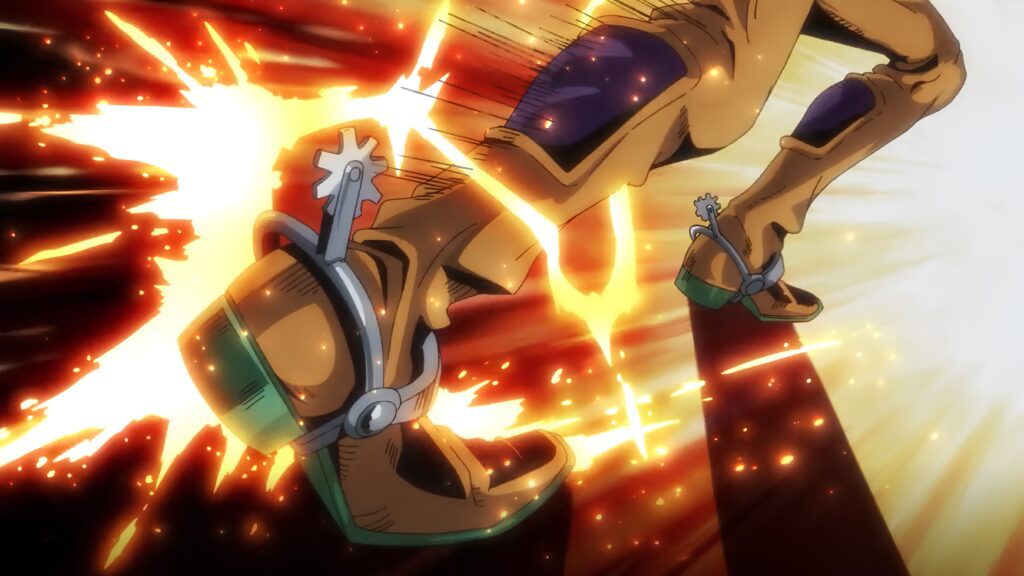
How did Gyro redirect the explosion to his leg? He used the Spin. When Oyecomova’s bombs were about to wreck his right hand, Gyro used the rotation of his Steel Ball to change where the explosion’s destructive effect landed, and his right leg took the damage instead.
That is the mechanical answer, and it is the easy part. The scene is more interesting for what it says about the Spin: a technique that lets Gyro choose where an attack’s consequences fall, used by a fighter who only reaches for it after his first plan has failed. It also comes with a price, which is why the escape feels earned. Spoilers ahead for the Oyecomova fight, adapted in Episode 5, “The Terrorist from a Faraway Country.”
How Did Gyro Redirect the Explosion to His Leg?
Gyro did not carry the bombs from one part of his body to another. The threat comes from Oyecomova’s Stand, which Netflix’s official October 19 recap describes as turning anything he touches into a bomb marked by pins shaped like clocks. Pulling a pin out sets off the explosion. Oyecomova touches Gyro’s right hand, and the pins that appear there become the problem.
The sequence in Chapter 22 runs like this. Gyro’s hold on the pins starts to fail, so he stops trying to keep the bombs in place and throws his Steel Ball, committing to an attack on Oyecomova. The Spin redirects the explosion’s destructive effect, which injures his right leg and leaves his right hand intact. The Steel Ball hits Oyecomova, who is forced to withdraw, and Gyro can pursue him.
What he did not do matters just as much. He did not remove the bombs, he did not reverse Oyecomova’s Stand, and he did not become immune to explosions. The blast still hurt him. He only controlled where it hurt.
The Spin Is Not Only a Weapon
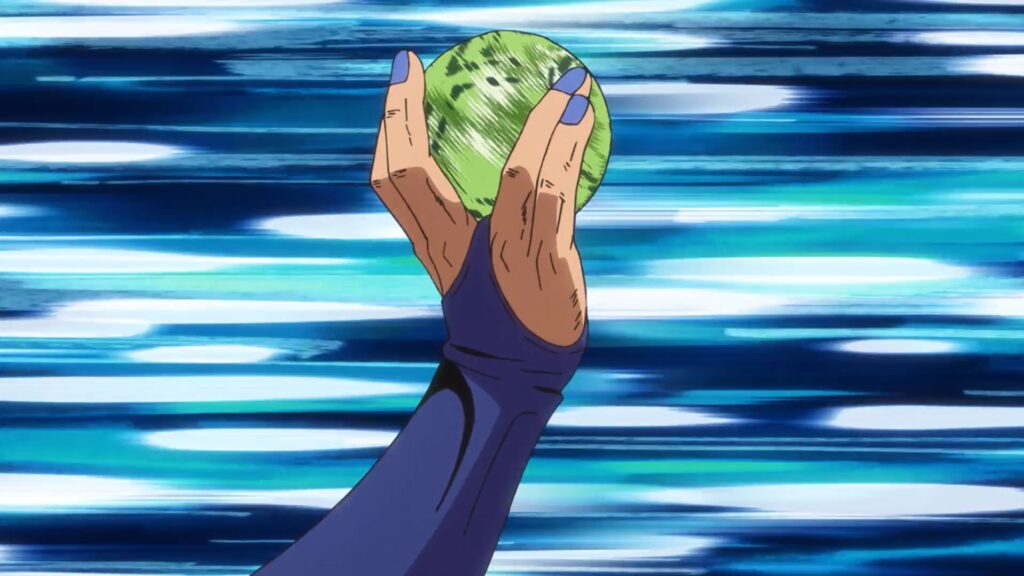
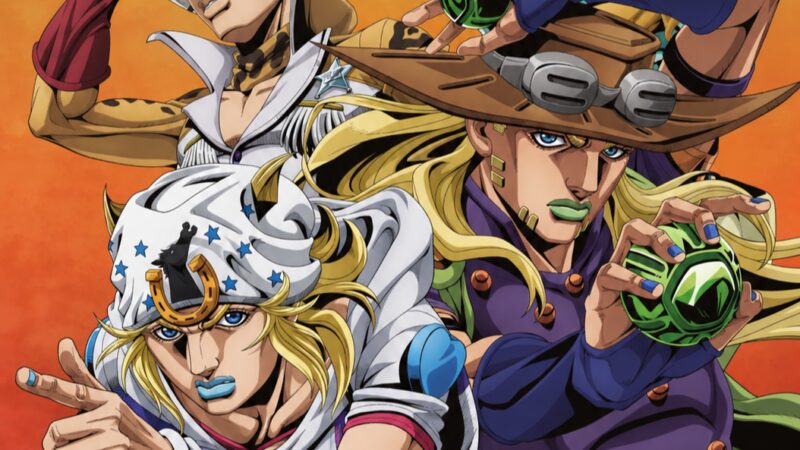
The anime’s official profile for Gyro describes his rotating Steel Balls as the source of seemingly impossible physical effects, and it names the technique as Kaiten, the Japanese word for rotation. Johnny Joestar’s profile gives an earlier example: Gyro’s Steel Ball temporarily lets Johnny move his paralyzed legs, and that experience is what draws Johnny to the Spin.
Set those beside Chapter 22 and a pattern appears. The Spin changes how a body responds to a physical effect, and here it changes where an explosion’s damage ends up. A fair reading is that its strength lies as much in controlling physical effects as in delivering a hard hit. At this point in the story the Spin is doing what it was already shown doing, and Infinite Rotation plays no part in the event.
Gyro Survives by Understanding the Threat
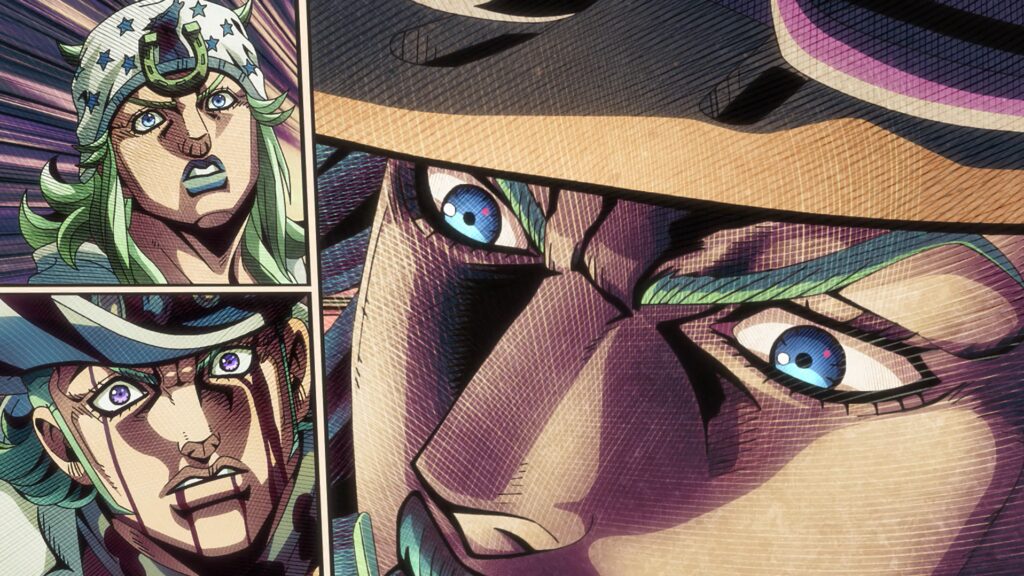
The redirection is not Gyro’s opening move. Mountain Tim helps him work out how Oyecomova’s attack functions: the pins must stay in position to avoid triggering the bombs. So Gyro keeps a tight grip on his Steel Ball to stop the pins leaving his palm, and when one comes loose he pushes it through the back of his hand to return it to place without opening his fist. That defense rests on a correct reading of the enemy’s rules and on a willingness to injure himself to keep them intact.
It cannot last. Gripping that hard makes Gyro sweat, and moisture makes the pins loosen, so squeezing harder does not fix anything. The bombs also stay dangerous after Oyecomova stops touching him, which means waiting will not save him. A purely defensive plan has to go.
That is why the redirection reads as a decision rather than a trick. A reasonable interpretation is that Gyro understood the mechanism well enough to see his defense would eventually fail, and acted before the situation became irreversible. The Spin gave him the means, but the recognition came first.
A Solution With a Cost
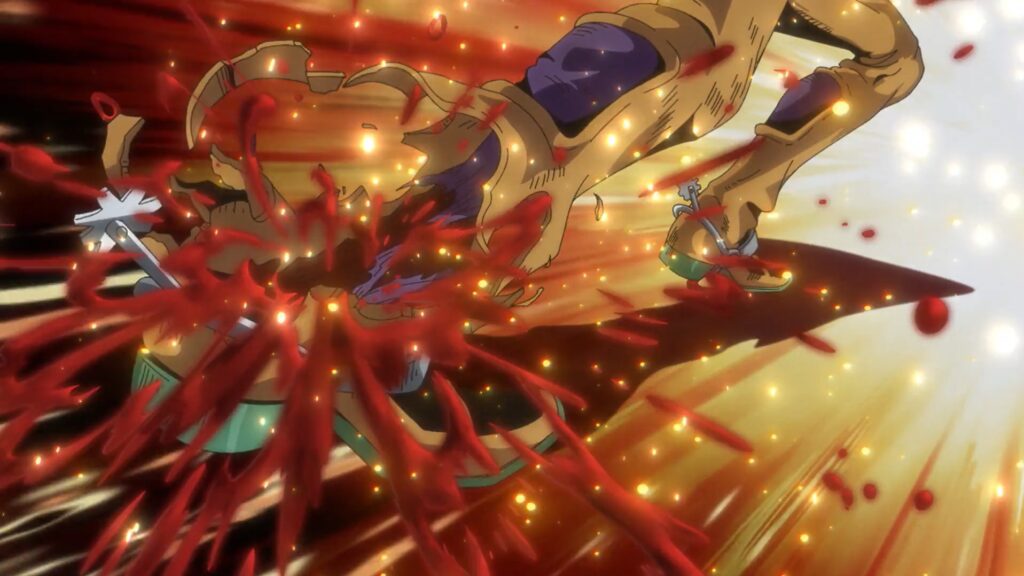
Gyro’s official profile identifies the Steel Balls and the Spin as the foundation of his abilities, so his right hand matters to everything he does next. Losing it would compromise how he handles and throws those weapons. Redirecting the damage to his leg gives him a better immediate chance of continuing the fight. That does not make the leg unimportant, least of all in the middle of a horse race. Gyro is choosing between two damaging outcomes and protecting the one he needs for his counterattack.
The counterattack belongs to the same decision. Oyecomova can keep creating bombs, so surviving one detonation would not end the danger. By striking him with the Steel Ball during the maneuver, Gyro protects his hand and puts pressure on his opponent at once. The scene suggests a fighter who would rather turn a defensive disadvantage into an opening than simply endure it.
The injury is also what keeps the moment from feeling like a cheat. The Spin gives Gyro a way to survive Oyecomova’s attack, but not a way to survive it unharmed.
Spin Against a Stand
Oyecomova’s pins come from a Stand, while Gyro’s answer comes from the Spin. No Stand ability is identified as the mechanism behind the redirection, and the scene does not hand Gyro an equivalent Stand of his own. It shows one successful application of the Spin against one particular attack. That is a narrower point than saying the Spin can answer every Stand, and it should not be stretched.
What the Redirection Says About Gyro
Gyro redirected the explosion by using the Spin to control where its damage landed, trading a destroyed hand for an injured leg. The scene works because a flexible technique, a careful read of Oyecomova’s ability and a real physical cost all arrive together. Take away the cost and it becomes a free pass. Take away the read on the enemy and it becomes luck.
Sources: Shonen Jump+ | Shueisha | VIZ | Netflix Tudum | Steel Ball Run official anime site