Can you watch Steel Ball Run without watching JoJo? Yes, and both the anime’s storytelling and its official promotion say so. Steel Ball Run begins a new continuity, introduces new protagonists and teaches its supernatural rules as it goes, so someone who has never seen Parts 1 to 6 can follow Johnny Joestar’s race from the first episode.
That doesn’t make the earlier parts irrelevant. Understanding Steel Ball Run and appreciating where it sits in JoJo’s history are different things, and the difference is worth weighing before you start. 10 episodes have streamed on Netflix as of November 22, 2026, which is plenty to judge it by.
Can You Watch Steel Ball Run Without Watching JoJo? Yes, Officially
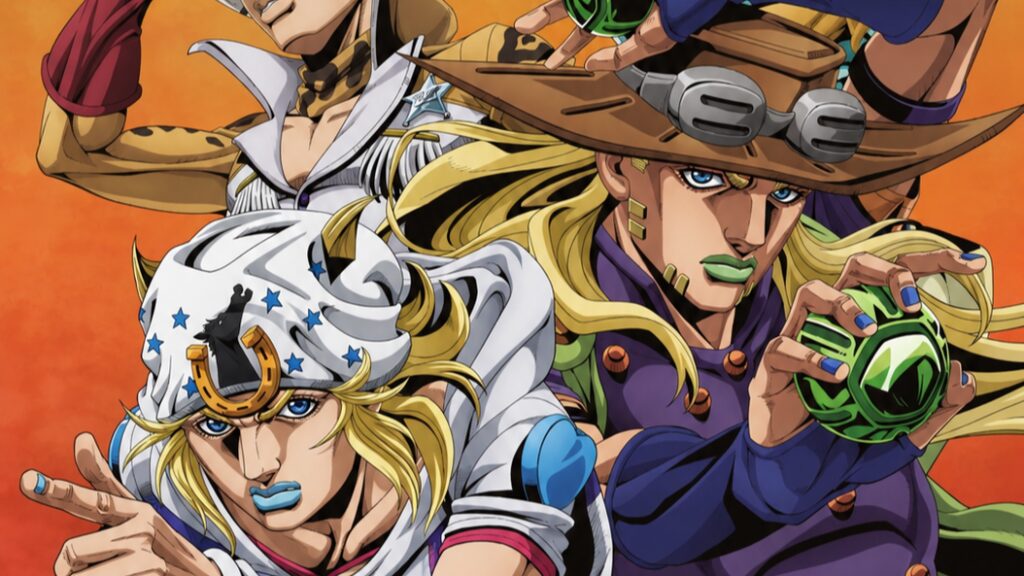
The official JoJo portal publishes a bilingual newcomer guide, Discover JoJo With Steel Ball Run, written for people who have never read the manga or watched the anime. It says Steel Ball Run begins a new story, that prior knowledge of Stands isn’t needed, and that newcomers can start with Johnny Joestar, Gyro Zeppeli and Diego Brando. One line settles it: “You can enjoy even without watching the previous series.”
Director Yasuhiro Kimura made the same point in an official interview published on March 18, 2026, calling the adaptation accessible to existing fans and to people who have never followed the franchise. He also named Johnny and Gyro’s relationship as the story’s central strength, and during script development he chose to keep their conversations rather than cut them to shorten the story.
The continuity backs this up. Part 7 starts a second continuity that JoJolion and The JOJOLands later continue, and in a May 2006 Shonen Jump interview Hirohiko Araki described it as a parallel universe to the earlier JoJo world. Its protagonists aren’t finishing anyone else’s unfinished mission.
Johnny Learns Alongside the Audience
Steel Ball Run is accessible largely because Johnny begins with no more knowledge than a newcomer. Episode 1 introduces him as a former horse racing prodigy who was shot and left paralyzed from the waist down. When he touches one of Gyro’s steel balls, he briefly feels movement in his legs, and that hope is why he enters the race: he wants to understand the secret behind Gyro’s abilities.
From there the anime teaches by letting him learn. In Episode 3, Gyro trains him in the Spin, a technique built on generating and transmitting rotational energy, and the camping and training scenes put Johnny firmly in the position of a beginner. Episode 4 does the same for Stands: Mountain Tim explains the Devil’s Palm and how it awakens powers in people, and Johnny starts developing one of his own. Episodes 7 and 8 take that power further, and Johnny names it Tusk.
The anime hasn’t laid out every Stand rule yet, and experienced viewers will recognize some conventions sooner. Recognizing a convention is not the same as needing it to follow the plot.
The Race Gives Newcomers Something to Hold
You don’t need JoJo lore to understand the stakes, either. The anime opens in a fictionalized America in 1890, where an international horse race will run from San Diego to New York: approximately 4,000 miles, nine stages and $50 million in prize money. Before any supernatural mystery matters, viewers already know what everyone is chasing.
David Production’s adaptation eases people in as well. Episode 1 is extended and covers the whole first stage, and Kimura discussed restructuring parts of the early chapters before the premiere. Documented changes include added scenes establishing Johnny’s interest in the race and some rearranged moments between him and Gyro. It would overstate the case to say every change was made for newcomers, though. A September 2025 production interview described giving Johnny enough prominence beside Gyro as a difficulty, and pacing and characterization were concerns too.
What Skipping Parts 1 to 6 Costs You
Skipping the earlier parts doesn’t remove a chapter of Johnny’s story. It removes the echoes. Johnny reimagines Jonathan Joestar with a different personality, physical condition and journey. The Zeppeli name and the mentor relationship recall William Zeppeli, and Diego’s name and ambition invite comparison with Dio Brando while his history stays separate. Longtime fans see the parallels and the departures. Newcomers simply meet three original characters.
The anime shows that each of them stands alone. Episode 6, “Gyro Zeppeli’s Destiny”, reveals that his family served as royal executioners in the Kingdom of Naples, that he learned the Spin as part of that profession, and that he entered the race hoping to save an innocent boy named Marco. None of it requires knowing William Anthonio Zeppeli or Caesar Zeppeli. Episode 10, released on November 20, 2026, covers Diego’s impoverished childhood and his mother, which explains his ambition without any knowledge of the original Dio.
There are smaller rewards too, such as an Urmd Avdul who recalls Muhammad Avdol from Part 3, and Spin sound effects that borrow familiar Ripple sounds, according to the JoJo wiki’s production notes. Kimura has also discussed how Steel Ball Run’s tone differs from Golden Wind, including its move from shonen to seinen publication. Newcomers can still appreciate that more mature storytelling; what they miss is watching Araki’s style evolve across six parts. Some later manga events may land harder for longtime fans, but naming them would spoil them for everyone else.
The 190 Episode Question
Parts 1 to 6 contain 190 episodes between them, a lot to ask of someone who just wants to see what the airing anime is about. What you want from the viewing decides how many you need:
Episodes Before Steel Ball Run
Pick your viewing order
| If you want | Watch first | Episodes before Steel Ball Run |
|---|---|---|
| Just Steel Ball Run | Nothing | 0 |
| Basic familiarity with JoJo | Parts 1 and 2 | 26 |
| Traditional Stand knowledge | Parts 1 to 3 | 74 |
| Every reference and parallel | Parts 1 to 6 | 190 |
These counts exclude Steel Ball Run’s own episodes.
These counts exclude Steel Ball Run’s own episodes. Someone who finds older anime a hard sell can try Part 7 first and go back later, and anyone who wants to join the weekly discussion can simply start with the airing season.
Community advice splits along the same line, though it is anecdotal. Reddit threads around the March premiere show newcomers asking whether Part 7 is a valid starting point, and another in November asked where to start during the current run. One commenter said you can start there but would still advise watching the rest to enjoy it fully. Another said you don’t have to, since it begins a new continuity, but doubted it would feel as satisfying without seeing how the writing evolved. Both treat Part 7 as workable; they differ on how much the earlier parts add.
Should You Skip Parts 1 to 6?
If your goal is to watch Steel Ball Run, yes. The official guide, Kimura’s comments and the released episodes line up: Johnny, Gyro and Diego are introduced from scratch, and the Spin and Stands are explained as the race goes on. Parts 1 to 6 offer something different. They won’t help you follow the story; they let you hear how it answers the ones before it. Start with Part 7, and the earlier parts will still be there when you want them.
Sources: JoJo Portal | Netflix | JoJo Wiki | Reddit